

How much does app development cost in Canada? (2026)
What app development costs in Canada in 2026: price ranges for simple, MVP, marketplace and enterprise apps, what drives the cost, and yearly upkeep.
Building a mobile app with a Canadian development company usually costs somewhere between $5,000 and $200,000 or more, and most business apps land in the tens of thousands. A simple app with a few screens and no accounts sits at the bottom of that range. An app with user accounts, payments and a backend costs more, and marketplaces and enterprise apps can pass $100,000. After launch, published estimates put upkeep at roughly 10% to 30% of the build cost every year.
Those are wide ranges, and two studios can quote very different prices for the same idea. The number of screens, the systems the app talks to, and whether it's built once for both iPhone and Android or twice, once for each, explain most of the gap.
App development cost in Canada by type of app
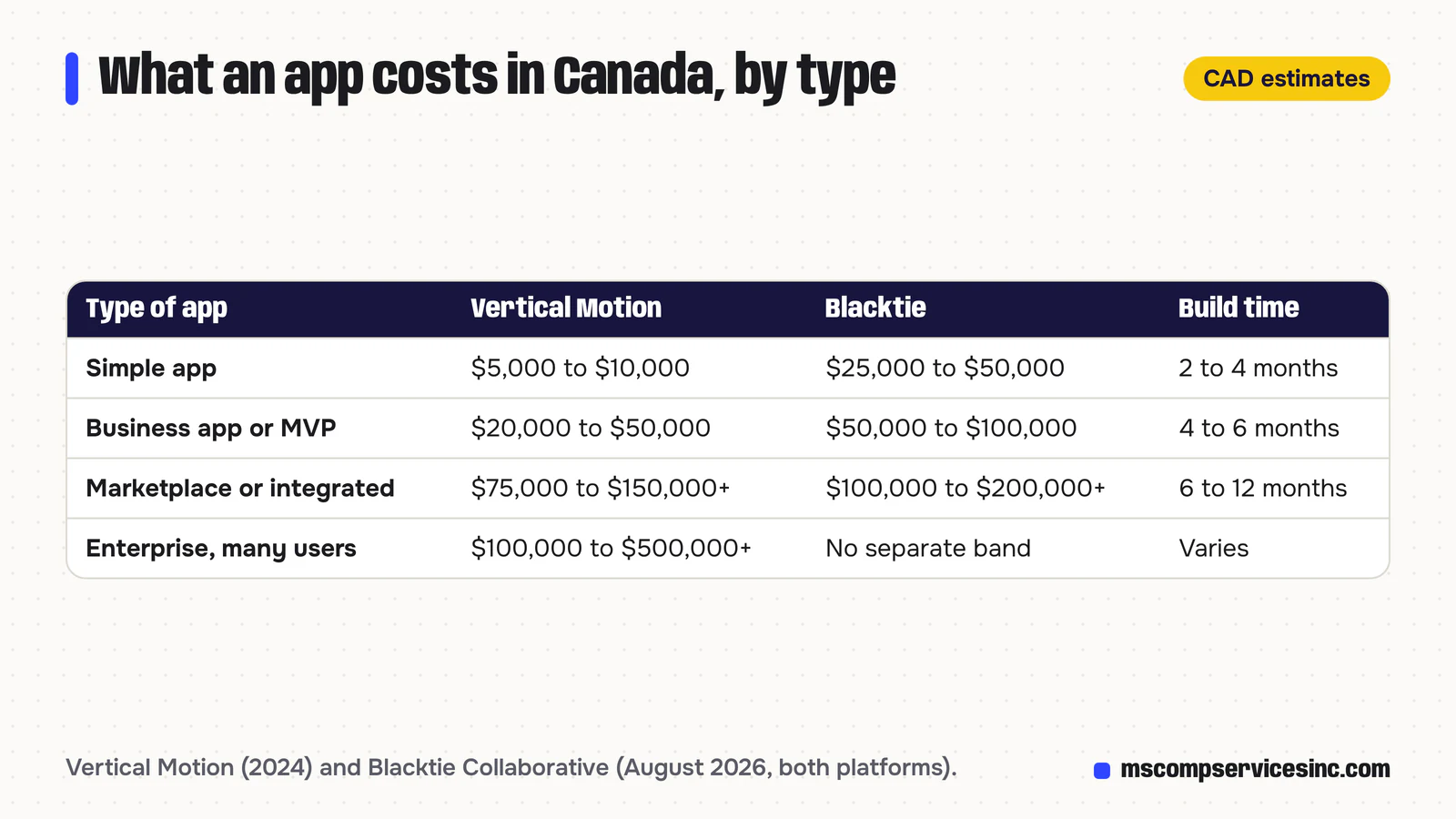
All figures are in Canadian dollars unless marked US$. They come from two Canadian app studios that publish their ranges: Vertical Motion, whose guide lists prices in CAD and dates from 2024, and Blacktie Collaborative, whose August 2026 guide uses Canadian rates for apps on both platforms. Both sell app development, and their ranges don't match. Use them to set a budget, then get quotes for your own app.
A simple app
A simple app does one job: an information app, a catalogue, a calculator, a list of locations, with no user accounts and little or no backend. Vertical Motion puts basic informational apps at $5,000 to $10,000. Blacktie's band for a simple, single-purpose app on both platforms is $25,000 to $50,000, built over two to four months. Blacktie's figure covers building for iPhone and Android, which is part of why it starts higher.
A business app or MVP
This is the app most businesses mean: customers sign in, book or order, see their history and get notifications, and the app reads and writes data on a server. An MVP (minimum viable product, the smallest version that does the core job) often falls here too. Vertical Motion puts apps that store users' data at $20,000 to $50,000. Blacktie lists a standard app with a backend at $50,000 to $100,000, taking four to six months.
A marketplace or on-demand app
Marketplaces connect two groups of users, such as customers and service providers, buyers and sellers, or riders and drivers. Each group needs its own screens, and the app usually needs payments, real-time updates, maps or messaging, plus an admin panel to run it. Vertical Motion puts apps that connect to third-party software at $75,000 to $150,000 or more. Blacktie's complex or real-time band is $100,000 to $200,000 or more, over six to twelve months.
An enterprise app
Enterprise apps serve many users with different roles and permissions, connect to several internal systems and often have to meet security or compliance rules. Vertical Motion's top tier, multi-user collaboration and sharing apps, runs from $100,000 to $500,000 or more. Apps for staff only can sometimes skip the public app stores, which takes out some of the launch work.
What drives the cost of an app
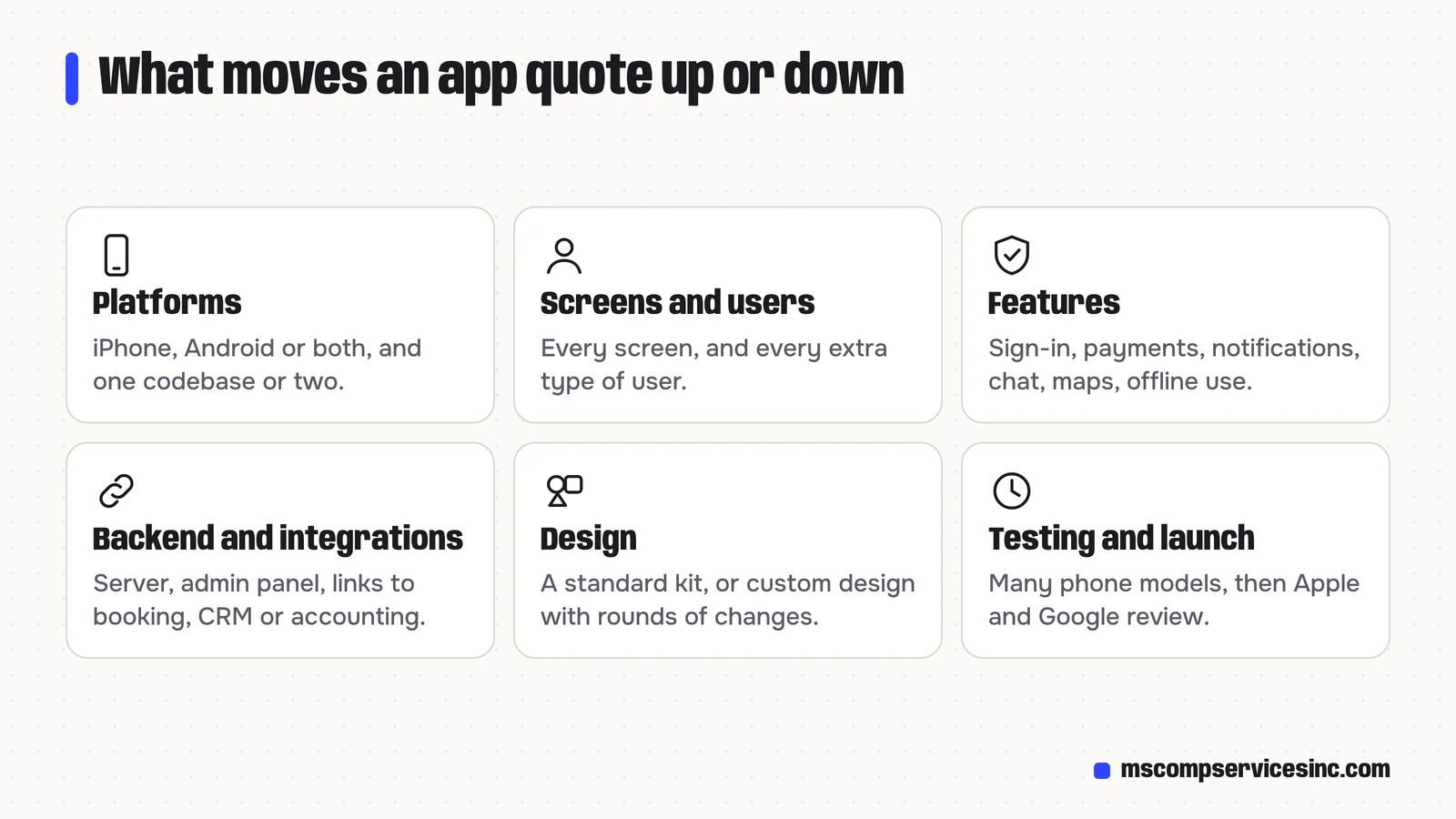
An app quote is mostly hours, and these are the things that add hours:
- Platforms. iPhone only, Android only, or both. Building two separate native apps is close to building the app twice.
- Screens and user types. Each screen is designed, built and tested. A second type of user, such as staff or providers alongside customers, adds a whole set of screens.
- Features. Sign-in, payments, push notifications, chat, maps, offline use, the camera or Bluetooth hardware each take their own design, build and testing time.
- Backend and integrations. Most apps need a server and a database, plus an admin panel so your team can manage content and users. Connecting to your booking, inventory, accounting or CRM software adds work for each system, and depends on how good that system's API is.
- Design. A layout from a standard kit is quicker than a custom design with several rounds of changes. Clickable prototypes cost time up front and save rework later.
- Testing and launch. Apps are tested on many phone models and screen sizes, then go through Apple and Google review, with store listings, screenshots and privacy details for each.
- Maintenance. Apple and Google release new operating systems every year, so an app needs regular updates to keep working. That's a running cost, covered below.
When we quote an app, the first two questions are who will use it and which of your systems it has to talk to. Those answers usually set the size of the project more than the number of screens does. You get a written scope, timeline and price for the first version before any code is written.
Native or cross-platform: how the choice changes the price
A native app is written separately for each platform, in Swift for iPhone and Kotlin for Android. A cross-platform app is written once in a framework such as React Native or Flutter and runs on both. A progressive web app (PWA) is a website that installs to the home screen and runs on any device without a store.
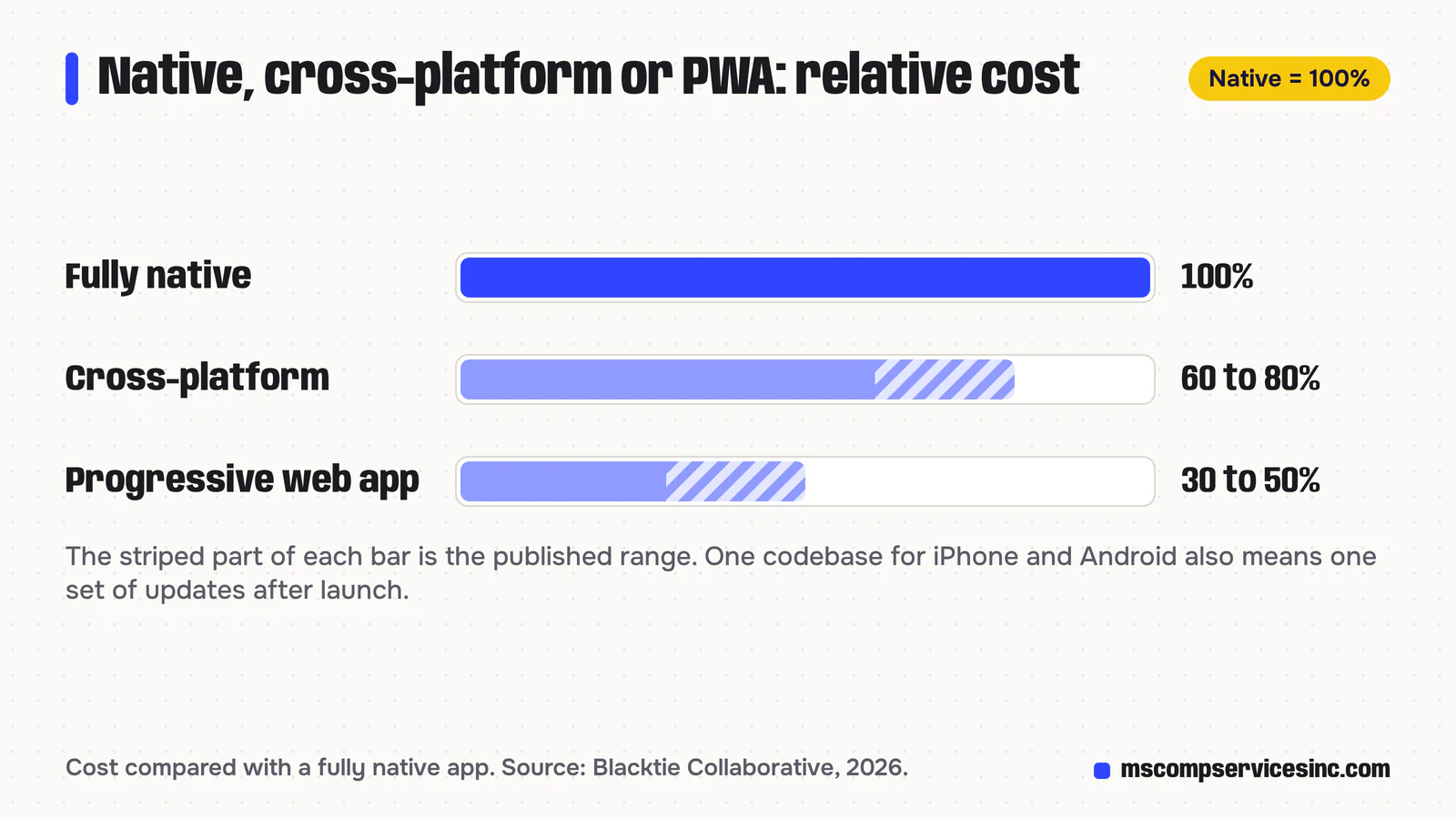
Blacktie's guide prices a cross-platform app at about 60% to 80% of the cost of a fully native one, and a PWA at 30% to 50%. Maintenance follows the same pattern: one codebase means one set of updates. Native still makes sense when an app depends on deep device features, heavy graphics or Bluetooth hardware. Our guide to progressive web apps explains what a PWA can and can't do on iPhone and Android.
For most business apps we use a cross-platform framework, so one codebase runs on iOS and Android. We recommend native code when the app needs special device features.
What an app costs every year after launch
The build is a one-time cost. These come back every year:
- Maintenance and updates. Vertical Motion estimates about 10% to 20% of the original build cost a year, and Blacktie 20% to 30%. That covers updates for new iOS and Android versions, security patches, library updates and small fixes, and new features are usually extra.
- Hosting and backend services. The server, database, file storage, push notifications and any paid services such as maps or SMS are billed monthly. Small apps cost little to host. Busy apps with many users cost more.
- Store accounts. Apple's developer program costs US$99 a year, or the local currency equivalent where available. Google Play charges a one-time US$25 registration fee.
- Store commissions. If you sell digital goods, services or subscriptions inside the app, Apple takes 30%, or 15% for developers in its Small Business Program and for qualifying subscriptions. Google Play's service fee is 15% on a developer's first US$1 million of earnings each year in most markets, and 15% on auto-renewing subscriptions.
Our article on how business apps help companies covers the other questions to settle before you build, such as security, offline use and whether an existing tool already does the job.
Ways to cut the cost of an app
- Start with an MVP. Build the one task users come for, launch it, and add features based on what they actually use. This is the biggest saving available, because features you never build cost nothing to maintain.
- Use one codebase. A cross-platform app or a PWA avoids paying for the same features twice.
- Check whether you need an app at all. If customers use your service once or twice a year, a fast mobile website may do the job. Our website cost guide gives typical prices for that route.
- Use what exists. Off-the-shelf booking, payment and sign-in services cost less than building your own, and an existing tool connected to your other systems sometimes beats a custom app.
- Write the scope down. A written list of screens and features before design starts keeps the quote accurate and the changes cheap.
We usually suggest launching a focused first version and planning the next features once real people are using it. During the build you install test versions on your own phone, so changes happen while they're still cheap.
App development cost in Regina and Saskatchewan
The published ranges are national, and none of the sources above break their prices down by city. For a Regina or Saskatchewan business, the bigger question is usually what the app has to connect to. A field-service app that sends job sheets to your office, or a booking app that reads your scheduling system, is priced mostly by those connections and by how many types of users it has.
A local developer can meet in person and knows the market. Most of an app project runs fine by phone and video call, though, and you'll install test versions on your own phone either way, so compare process, past work and support after launch before distance.
We don't publish fixed prices for apps, because a single-purpose staff tool and a two-sided marketplace are different projects. Our mobile app development page explains how we work, from discovery to the app stores. For portals and internal tools that run in a browser, see custom software development. Tell us who will use the app and what they need to do in it, and ask for a free quote. You'll get a written scope, timeline and price for the first version before any code is written.
Quick answers
How much does it cost to build an app in Canada?
Published estimates from Canadian studios run from about $5,000 for a basic informational app to $100,000 or more for marketplaces and apps with many integrations, and past $200,000 for large enterprise apps. Most business apps with accounts and a backend fall in the tens of thousands. The number of screens, features, integrations and platforms sets the price.
How much does an MVP app cost?
An MVP with sign-in and a backend usually falls in the business app range: $20,000 to $50,000 in Vertical Motion's estimates and $50,000 to $100,000 for a standard app with a backend in Blacktie's. A narrower MVP that does one task costs less. Starting small also means less to maintain each year.
Is a cross-platform app cheaper than a native app?
Usually. One codebase runs on iPhone and Android, so you build and maintain the features once. Blacktie's 2026 guide prices a cross-platform app at about 60% to 80% of a fully native one. Native code is still the better choice for apps that rely on deep device features or heavy graphics.
How much does it cost to maintain an app each year?
Canadian studios estimate roughly 10% to 30% of the original build cost a year for updates, fixes and support, plus hosting and backend services. Apple's developer program costs US$99 a year, and Google Play charges a one-time US$25 registration fee.
How long does it take to build an app?
Blacktie's 2026 guide gives two to four months for a simple app, four to six months for a standard app with a backend, and six to twelve months for complex or real-time apps. A focused first version gets to the stores sooner.
Want help with this?
Tell us about your business and we'll send a free quote, or call 1-800-944-3688.